When you sign up to participate in a P2PU course you're asked a number of standard questions about why you're interested in a course, what you hope to get out of it, and whether you'd like to get involved in organising. You can also be asked some more specific questions relating to the selected course. The following are my answers to the questions asked when I joined the Virtual Worlds, Games and Education Tour course. You fill them in on a web form, and I wasn't expecting it, so they're off the top of my head stuff (except for the wikipedia link). I'm posting here so that I can see whether my thoughts have changed after participating.
Do you think there is a difference between a virtual world and a MMORPG?
Yes, I think so, though I'm a bit hesitant in my answer, not having really ever experienced MMORPGs. I know of WoW, and I might be able to come up with a name of another, but that's not too promising. On the other hand I can name a fair few virtual worlds and synthetic environments.
My first reason for differentiating is based on the role playing aspect. I am assuming that the RPG of the MMORPG title indicates that you would always be role playing. Conversely I'd suggest that while you might role play in a virtual world, it's not a given - you might just as well be 'playing' yourself. If there are MMORPGs where you play yourself my argument would get fuzzy... I look forward to learning more!
I'd also look at the use of the term 'game' in the MMORPG title. Do games by necessity have aims and rules? If so, I'd say that virtual worlds differ in that (while users in them in a particular context might have or impose aims or rules) they generally promote more free exploration, without any particular set of objectives. Users might enter and user a virtual world for a whole range of reasons, and these may or may not include gaming.
Do you think most people would agree with you?
Most people? Most people I speak to don't know what a virtual world is! There are plenty who haven't heard of even the big names like Second Life. I would have thought the same applies to MMORPGs. Despite a fairly geeky background and job I still don't actually know anyone who uses both virtual worlds and MMORPGs (if indeed they are different).
What virtual worlds or MMORPGs do you use regularly or have you experienced?
I'm not currently in any worlds or MMORPGs regularly. I'm just now beginning to explore Second Life some more, having previously used OLIVE, Teleplace (before the open source developments) and VBS2 through my work. I've never knowingly (!) used any MMORPGs. I might be missing out on something!
Second Life sites: ISTE Island CAVE (Community of Applied Virtual Educators) Virtual Pioneers EdTech Island
Educator Research Groups and Social Media: ARVEL – Second Life group ISTE – Second Life group Virtual Pioneers – Second Life Group AERA ARVELSIG twitter @arvel
Discovering the My Citations section of Google Scholar - and that I have way more citations than I expected. Disappointingly though, because I currently don't have an educational institution email address, Google won't display my profile in Scholar searches. Boo.
Following links to those who have cited me and finding the excellent (well, it looks it - I haven't read it yet) book Emerging Technologies in Distance Education by George Veletsianos, which showcases the international work of research scholars and innovative distance education practitioners who use emerging interactive technologies for teaching and learning at a distance...
And then finding that while the book isn't available as an eBook on Google books, and is just shy of £30 on Amazon, George, being a proponent of emerging technologies and pedagogies and digital scholarship, published the title under an open access license entitled Emerging Technologies in Distance Education, which can be downloaded for free at http://www.aupress.ca/index.php/books/120177. Thank you George!
Donald Clark has started an amazing blog marathon: 50 blogs on learning theorists over next 50 days. He's writing profiles on key figures in learning, theorists, practitioners and those directly relevant to e-learning. The coverage is quite fantastic... and will build into a super series. Thank you Donald!
I happened across a Tweet the other day from someone who's not in the technology or elearning fields himself, but is interested in community engagement and knowledge sharing. He'd heard about P2PU and was flagging it as an interesting idea. I followed the link, and came to the same conclusion.
The Peer 2 Peer University describes itself as "a grassroots open education project that organizes learning outside of institutional walls and gives learners recognition for their achievements. P2PU creates a model for lifelong learning alongside traditional formal higher education. Leveraging the internet and educational materials openly available online, P2PU enables high-quality low-cost education opportunities. P2PU - learning for everyone, by everyone about almost anything."
That sounded interesting. Worthy aims which I happily buy into. But what interested me more was what I found when I dug a little deeper. Courses, free to register and participate, in interesting fields encompassing webcraft, social innovation, mathematical future and education; attractive of course. But as it happens, despite an awareness of MOOCs, I've not had the opportunity to participate before, and that in itself is a further exciting personal and professional elearning experiment for me. So, now is the time!
I've signed up to A Virtual Worlds, Games and Education Tour. It's a four week course exploring virtual worlds, games and emerging technology for use in education. It includes tours on topics covered at VWBPE 2012 or the Virtual Worlds Unsymposium which I really wish I'd been involved in, field trips to educational sims in Second Life, an introduction to Machinima, an adventure in the MMORPG World of Warcraft with an educators' guild and finally some tours on the Bleeding Edge with emerging technology and education that includes virtual, blended and augmented realities. The virtual world field trips are scheduled for evenings in Pacific Standard Time, which puts them in the middle of my night, but some might be manageable - and the helpful organisers have left introduction cards in world to allow you to explore yourself. I'm really looking forward to sharing this with other participants through the P2PU facilities and the portal put together by the course facilitators. I'll be tagging any blog posts related to the course with the vwmooc label.
MOOC? What's that? It's a Massive Open Online Course - and it's different from conventional eLearning in a number of ways. Course materials may be provided by facilitators, but the onus rapidly moves to the participants for content development. The use of web technologies to create, share, aggregate, curate, comment and interact is absolutely central. Essentially, the MOOC is an educational tool which exploits the theory of connectivism and uses an open pedagogy based on networked learning. MOOCs are founded on principle characteristics of autonomy, diversity, openness and interaction.
But what does that mean in practice? Take a look, for example, at the Change MOOC, currently running from Sept 2011 to May 2012 which is a very comprehensive MOOC. In fact, it's got so much going on that it can be pretty daunting, probably particularly for those new to web 2.0 technologies. You need to keep up with the weekly email, read some recommended texts, document your responses, share and discuss these with others, perhaps engage in other activities. And you want to keep up with the blogs of your colleagues - they have a lot to say which is very interesting, and you wouldn't want to miss it, or their Twitter comments... and very quickly it's become unmanageable! Well, it doesn't have to be overwhelming, and perhaps part of the secret in this is knowing from the start that the course is Massive. You won't be able to keep up with all that's interesting that happens. That might be disappointing, but you can bet that as long as you are engaging somewhere and somehow with other participants you will be right there at the heart of the juicy stuff.
"This is an unusual course. It does not consist of a body of content you are supposed to remember. Rather, the learning in the course results from the activities you undertake, and will be different for each person.
In addition, this course is not conducted in a single place or environment. It is distributed across the web. We will provide some facilities. But we expect your activities to take place all over the internet. We will ask you to visit other people's web pages, and even to create some of your own."
There's also a good video introduction to what a MOOC is here:
So, a MOOC is a 'connectivist' course, which involves learners in four major types of activity:
1. Aggregation
You read, watch or play with content, selecting what is interesting and appropriate to you individually. It's fine (and expected) that you you won't read it all. You can ignore things if they are too hard or don't interest you. Some courses might provide more tasks or instructions, others might point to existing web content, yet others may produce content specially for the purpose, for example the daily email delivered to participants of the Change MOC.
2. Remixing
You need to keep track of the content you've seen or used. Participants are encouraged to record this online in a way which can be shared, for example by blogging, using del.icio.us, joining in discussion groups, commenting on Twitter, or indeed any other Internet tool of choice, from photo and video sharing, to virual worlds or social network sites.
3. Repurposing
This is where participants create something of their own, based on the materials they've engaged with. This can be daunting, but the Change MOOC facilitators remind us that you are repurposing - not starting from scratch. Participating in a MOOC is very much not just about absorbing the content you're presented with. It's about engaging with the content and with others, and your learning emerges from this. The course is more like a toolbox, giving you the context in which to develop your skills. It's acknowledged that producing content for themselves, and more importantly sharing it, can be nervewracking for learners. In my own experiences of the OU's MAODE programme, many people, including myself, were initially nervous about blogging, but as the course developed it soon became clear what a valuable tool it was - a journal, a record of your research, your personalised revision notes, your conduit to contacts, a place to receive feedback, and jumping off point for discussion... more than any of us would have imagined before getting involved. I'm sure MOOCs feel like this tool - frightening and exciting to start, but rapidly proving themselves transformative, and continuing to do so time and time again.
4. Feed Forward
Participants are encouraged, though never compelled, to share what they produce with other course participants. Sharing is scary, but that means you think hard about what you produce, and with that comes greater satisfaction. Sharing might be through using Twitter or del.icio.us hashtags, sharing RSS feeds to your blog.
If you're still with me(!), George Siemens has drawn together an interesting view of the conversations surrounding MOOCs and how they differ from more conventional online courses, in a blog post.
I'll give (almost) the final word to the Change MOOC's facilitators again:
"When a connectivist course is working really well, we see this great cycle of content and creativity begin to feed on itself, people in the course reading, collecting, creating and sharing. It's a wonderful experience you won't want to stop when the course is done.
And – because you can share anywhere – you won't have to. This course can last as long as you want it to."
Now, doesn't that just sound like something you really have to get involved in? I know I'm excited!
I'm focusing on my ECA (end of course assignment, in place of an exam) at the moment. I'm designing specifications for learning activities using web2.0 tools and assessment practices. I'm obviously not allowed to post what I'm up to though!
This was a nice 2:35 minute diversion from trying to write (unfortunately I have more diversions than writing, but that's another problem!).
Part of the world’s most watched Social Media video series; “Social Media Revolution” by Erik Qualman. Based on #1 International Best Selling Book Socialnomics by Erik Qualman. This is a shorter version that includes new social media statistics for 2011.
‘Experiences of assessment: using phenomenography for evaluation’ (Jones and Asensio, 2001)
This paper explores the use of assessment as a tool for structuring students' experiences in a networked learning environment. The phenomenographical approach aims to explore people's qualitatively different ways of experiencing the world. In this case, this was studied through the use of interviews with tutors and students on the Open University 'Information Technology and Society (THD204)' course which used conferencing for communication and in two assignments.
Key points
"Theproblems of interpretation and the understanding of others' intentions are fundamental to collaboration" (schwartz, 1999) - in an online, distance learning environment, documentation and the interpretations given to documentation become critical.
It is "extrememely difficult to design an online course [or] activities in ways where you are not surprised and/or disappointed by the output".
Student participation is a common concern - and a common response to to redesign a course with more and tighter control over the learner's choices and pace of interaction/contribution; this was recognised that "the tighter the schedule the more structured the exercise is and there is a danger that you're damping down ont he potential for creativity".
"it is possible to use assignments as a vehicle for encouraging students to adopt new patterns of learning, whilst at the same time covering course content" (Macdonald et al, 1999) - but for this to be achieve, students must have a clear understanding of the course designers' intentions.
Students' experiences vary in what may be unpredictable ways for the course designers' intentions.
Students can interpret the aims of assessment differently - even if they are in a co-operative group tasked with a joint project! In this case, this was despite 12 pages of detailed instruction.
Course designers cannot control the background and context in which students interpret instructions or assessment criteria. Even course documentation aimed at students who have many external factors influencing their interpretation may be misinterpreted.
Distance/networked learning may suffer more from differences in student interpretation because the interpretation of context by students is more vulnerable to variations in setting than in face-to-face settings.
The approach adopted by the teacher is a key variant in helping to determine a student's approach to learning (Prosser and Trigwell).
The variation in student interpretation might imply that "teaching interventions were necessary to negotiate understanding 'on the fly' and that a cautious attitude needed to be adopted to reliance on the use of course documents in a networked environment."
Reflections
There were a lot of clarification questions asked in our tutor group and course forums about each of the assignments on H807. This would suggest that (some) students indeed did not have a clear understanding of the course designers' intentions. As in the course described, course designers almost certainly believed that they had produced comprehensive and complete guidance about assessment. I wonder if the level of student anxiety and confusion increases with the weigting of the assignments - if that is the case, I would expect to see the greatest level of uncertainty yet in the coming weeks as we approach the End of Course Assessment.
In the example given, students were using conferencing for collaboration for their assessed tasks. They had only used it for collaborative work once before, so it was unfamiliar to them. This raised questions in my mind about whether this assessment therefore effectively reflected the ways of working which had been previously taught and experienced on the course, or the learning objectives as known to the students.
I wondered whether the difficulties in designing and preparing sufficiently detailed standard documentation might also be mirrored in the design of scaffolding, particularly of group activities. There will be variation in student skills, knowledge and experiences, and therefore scaffolding at any particular level may or may not suite the individual student. How can the individual 'turn off' scaffolding which is built into group activities? Do they just have to sit through (cruising, with little challenge or development) those activities for which they need less scaffolding, but which they are still supposed to engage in? There needs to be a balance between scaffolding and challenge (see Dearnley), but there also needs to be a balance in the way scaffolding is designed bearing in mind the range of experience of a mixed group of learners.
Reference:
Jones, C. and Asensio, M. (2001) ‘Experiences of assessment: using phenomenography for evaluation’, Journal of Computer Assisted Learning, vol.17, no.3, pp.314–21.
‘Rethinking learner support: the challenge of collaborative online learning’ (Thorpe, 2002)
This paper looks at course design and learner support, and the blurring of the boundary between the two which occurs in online learning facilitated by computer-mediated communication. Traditionally learner support has been that which happens after course materials are developed. However, in courses with considerably less pre-planned material and greater emphasis on generation of course content through online interaction and collaboration, course design and learner support start to merge.
'Learner support' in open and distance learning has a specific meaning, referring to:
guidance about course choice,
preparatory diagnosis,
study skills
access to group learning, etc.
Key points:
Use of technology does not guarantee collaborative and constructivist approaches to learning - this depends on how the technology is used -> course design.
It is important to make sure that we do not lose the values of conversation and community in technicist approaches.
Learner support is not just provided of 'done to' the student; support is produced and consumed simultaneously - the learner must participate actively, as must the tutor/supporter.
Key functions of learner support are:
response, and
responsiveness, in relation to three essential and inter-related elements: identity, interaction and time/duration.
Thorpe defines learner support as 'all those elements capable of responding to a known learner or group of learners, before, during and after the learning process.' Therefore, pre-planned course materials or computer programmes, which cannot respond, cannot offer support.
Thorpe's three elements of learner support:
Identity - the supporter knows that the learner is a person with an identity. Identities also change in parallel with progress through a course, so support needs to be appropriately modulated.
Interaction - learner support is essentially to do with interpersonal interaction -> learner support is therefore also culturally specific. Interaction is key to all main theories of learner support
Time/duration - learner support is a 'live' process which has duration. It is defined by the actions of the learners and supporters involved, and so is a dynamic and not wholly predictable process.
Electronic communication has been used to provide another medium for support, rather than changing its nature. Online learner support is, however, increasing the frequency of learner to learner and learner to institution contact.
Online, collaborative approaches may be experiences as reducing an individual's freedom to study at their own pace (Thorpe, 1998).
Changes in course production (with increase in collaborative, constructivist designs) may mean lower initial production costs are feasible, but "costs during presentation are likely to increase, to sustain the IT infrastructure and realise the benefits of continual updating and learner support online".
"It takes considerable ingenuity, design and appropriate educational goals in order to achieve a course where interaction online is absolutely essential in order to pass, rather than a highly desirable enrichment.
Reflection
I'm feeling slightly hazy about the scaffolding/support distinction. Thorpe argues that computer programmes can't offer support as they are unable to recognise human identity, but previous literature on scaffolding has suggested that computer tools can provide scaffolding...
Thorpe's comment on increasing costs is interesting. It stands in start contrast to the view/argument/sales pitch that online learning will be cheaper. Thorpe's arguments about the importance of community and constructivist learning are persuasive - if we move to cheaper to produce 'one size fits all' design then our learner support provision will undoubtedly be weakened, and our opportunity to develop engaging constructivist learning will have been missed.
Reference:
Thorpe, M. (2002) ‘Rethinking learner support: the challenge of collaborative online learning’, Open Learning, vol.17, no.2, pp.105–19.
‘Learner support services for online students: scaffolding for success’ (Ludwig-Hardman and Dunlap, 2003)
This paper describes a number of learner support strategies implemented with the aim of reducing students' feelings of isolation, lack of self-direction and motivation, and which lead to higher drop-out rates for online courses (typically 20-50% according to the authors).
Key points:
Self-directed learning skills are developed in a social context, through interactions with peers, teams, communities of practice, etc.
To be successful, learners need the skills required for effective online learning; these skills need to be explicitly taught and supported.
"Most descriptions of learner support focus on systemic characteristics" (e.g. administrative, registration, etc) - the cognitive function (e.g. guidance, counselling, assessment, coaching etc) is often ignored.
The authors describe the following programme, specifically designed to help students to choose the right course, to identify and develop the skills they will need, and to feel part of a community:
Diagnosing fit between learner and education provider
intake interview - discusses expected learning outcomes of a course and relationship to the learner's goals
online tools to enable self-assessment of eligibility and preparedness - students assess their competencies, learning objectives, short and long-term goals, etc.
diagnostic pre-assessment of learner's strengths, weaknesses, etc - used as a tool to identify strengths and areas for improvement
Learning Orientation Questionnaire from (www.trainingplace.com) - determines readiness for online learning - looks at 3 factors: learner's emotional investment in learning, strategic self-directedness and independence/autonomy.
Orientation to the online learning experience - a 4-week course with a high level of structure, introducing learners to the community, communication tools and learning skills required.
One-to-one advice provision - encouraging learners to articulate their learning goals and plans, helping them to understand their learning orientations, strengths and areas for improvement, advising on the exploration and selection of learning opportunities and encouraging learners to evaluate their own progress.
Access to a community of learners - allowing a sense of connection with the institution and with other learners - the learning community is based on the programme in which the learner is enrolled and includes threaded discussions, online chats, role plays, interviews, etc, organised by mentors on specific topic areas. More experienced learners move from the periphery to the centre of the community - "legitimate peripheral participation (Lave and Wenger, 1991).
Reflection:
The authors cited DeVries and Wheeler (1996), arguing that students may drop out of a course because they do not feel part of the community. I found this hard to relate to. I feel that if I need the qualification or have any other motivation for my learning, other than a desire for academic community engagement, then I can't see that I would quit. I might be disappointed, and I might be benefiting less from the course than one which offered substantial interaction, but I feel I would still be likely to continue. Perhaps this is a reflection of my personality, generally fairly independent and self-motivated, or perhaps it's something to do with a degree's worth of distance learning which very little community engagement (OU 2002-2005 - face-to-face tutorials, and online group activities only in a couple of courses, and then only a fraction of the activities), so again, I got used to studying without a community around me. That said, I was aware that I wanted community, and the desire to be part of an academic community was one of the motivating factors in applying for my PhD at a campus-based university.
The orientation programme described seems a thorough start to getting students engaged in the community and the distance learning environment. It has a lot of similarities to early stages of Salmon's five stage model. However, the orientation seems to happen separately to the learner's subsequent courses, i.e. with a different community to that which the student will then interact with. The monthly rolling start of courses mean that students will not be progressing in parallel with a large cohort, so the community is deliberately created from students in related courses, but not all at the same stage. While this allows students with increasing expertise to take a more central role, including scaffolding new learners, Salmon's model is harder to apply as students will not be working on tasks together, and I was concerned that the progression through the model's stages may be interrupted if students develop early socialisation with their orientation group, but then have to move on to a different community for their main studies. For me, this provision of community access and development tools, joining students from a wider network, was also reminiscent of the unofficial OU student society online conferences, particularly psychology, which I experienced 5-10 years ago. These were entirely separate from the official courses, but included much inter- and intra- cohort sharing and discussion, and were extremely valuable as the courses at the time had little or no 'community' built in.
I feel uncomfortable about the LOQ. Psychological instruments which are a) for sale b) include "testimonials" on their web site, and c) include the words "recent advances in neuroscience" in their overview blurb ring alarm bells for me. I don't have time to research the deep background of the LOQ... but was reminded of this ;-)
Ludwig-Hardman, S. and Dunlap, J.C. (2003) ‘Learner support services for online students: scaffolding for success’, International Review of Research in Open and Distance Learning [online]http://www.irrodl.org/index.php/irrodl/article/view/131/211
‘Student support in open learning: sustaining the process’ (Dearnley, 2003)
Dearnley explores the types of support required, and the structures which provide them, by adult, open learners. The context of the paper is around nursing education, offering conversion courses to otherwise have limited (if any) experience of higher education, but the findings are thought to be transferable to other adult learner groups.
3 major supporting networks sustain learning and development: academic, professional and social, providing 3 types of support: practical, academic and emotional.
Key points:
Appropriate student support can make the different between student success and failure.
Student support plays a crucial role in sustaining the process of learning and development.
Students will experience life responsibilities (which are generally constant and predictable) and life events (which should be expected, but what or when is unknown; should be accommodated by curriculum designers).
Support networks need to interact - and the academic network (in particular) may need to react to changes in the other two (for example if social or professional support breaks down).
Social networks seem to form the foundation of all support networks - ""domestic harmony" is an essential ingredient in sustaining the motivation and ability for mature learners to continue studying".
Students rely on a complex mix of emotional and practical support from within their social and professional networks.
Students beginning from a received knowledge (i.e. the "authority" is always right, I must learn all the facts") orientation may be used to or expect the tutor/course to tell them what to think or do. Taking responsibility for their own learning can be a substantial challenge.
Academic peers provide academic, practical and social support. Group tutorials in particular can be useful for friendship, developing trust and motivation.
Good tutors provide support in the academic, emotional, practical and technical domains. The must be approachable and accessible - knowing that support is available can be more important than the means by which it is accessed.
Development requires a mixture of challenge and support - too much or too little of either will reduce the potential for development.
Reflections:
Studying (particularly in parallel with a job or family commitments) requires a re-alignment of priorities and activities, especially domestic roles and responsibilities. I've been fortunate that my own circumstances have allowed this to happen quite smoothly, but I still strongly related to the statement that domestic harmony is necessary for motivation and continuation of studying - when other aspects of my life, (eg. health, relationships or work) have been harder, my energy for studying is very rapidly depleted.
Has our own tutor group supported me through this? I suppose it has given me the visibility that some of my peers are struggling in similar ways, and so reduced isolation. Practical study related help such as supplying links and resources has also been useful. However, ultimately I still feel like I have to get through this pretty much on my own wits - if I let myself slip so far behind that I cannot catch up, then that's my fault, so it's up to me to pull myself up by the bootstraps. That said, the experience of seeing wide fluctuations in the level of contributions to our online forum does help to remind me that I don't have to respond to every activity in complete fullness and perfectly on time - there's a wide variation in what is acceptable, after all, this is open learning at Masters level, and so responsibility for one's own learning management is an expectation.
The paper notes that students beginning from a received knowledge orientation are likely to be less tolerant of ambiguity, to collect facts and to be surface learners. While I think (hope!) I'm generally fairly well engaged in the knowledge construction this course affords, at times, perhaps when I'm tired, that effort of having to think, question, re-process for myself can feel hard. Similarly, if I "get" something straight away then I'm likely to be able to quickly move on to elaboration or application of the information, but if it was a concept I found more challenging then I can be inclined to slip into attempting surface learning. I think here that blogging really helps me, as it's often not until I try to start writing that my thoughts and reactions emerge... and then I write much more than planned (like this post which I meant to finish half an hour ago - a useful lesson in why these activities sometimes take me longer than I wish ;-) ).
'Learner support in distance and networked learning environments: ten dimensions for successful design’ (McLoughlin, 2002)
McLoughlin's paper explains scaffolding ("the effective intervention by a peer, adult or competent person in the learning of another person") and gives some of the history and background, particularly Vygotsky's Zone of Proximal Development.
The paper compares scaffolding in face-to-face learning with that which might be required in online and distance situations, and argues that the principles of learning support can still apply to these newer teaching and learning contexts.
McLoughlin refers to seven short pieces of advice:
Provide experience of the knowledge construction process
Provide experience in and appreciation of multiple perspectives
Create learning asks that are relevant and authentic
Encourage ownership and voice in the learning process
Embed learning in social experience
Encourage the development of multiple modes of representation
Encourage self-awareness of the knowledge construction process.
McLoughlin also argues that effective scaffolding is characterised by:
increasing the learners’ chance of succeeding in a task
helping them to do something they couldn’t accomplish on their own
moving them to a ‘new and improved zone of understanding’
helping them to operate independently.
McLoughlin provides ten design guidelines/dimensions of successful learner support. Each dimension is represented as a continuum with contrasting values at the ends. She points out that it is necessary to combine the individual dimensions in order to create effective instructional scaffolds.
The dimensions are:
(1) Goal orientation (i.e. the goal of the support; support should be planned, not only when learners are having difficulties)
Highly focused <-----> Unfocused
(2) Adaptability (meet the needs of a diverse range of students)
Fixed <-----> flexible
(3) Accessibility (available when the student needs is - "just-in-time")
High <-----> Low
(4) Alignment (support is aligned with task goals and learning outcomes)
High <-----> Low
(5) Experiential value (learners' experiences allow them to plan, act, reflect and transfer knowledge of skills to new tasks/contexts)
High <-----> Low
(6) Collaboration (emphasis on social constructivism and use of web tools to support collaboration suggest this dimension is already well accepted)
Supported <-----> Unsupported
(7) Constructivism (support knowledge construction (strong scaffold), not memorization (weak scaffold))
Strong <-----> Weak
(8) Learning orientation (scaffolds allow learner to progress from teacher regulation to self-regulation and self-direction)
Teacher regulation <-----> Learner regulation
(9) Multiplicity (various types of scaffolding to support aspects of learning such as metacognition, reflection, articulation and comparison)
One-dimensional <-----> Multi-dimensional
(10) Granularity (high granularity allows learners to select and reconstruct the parts that are meaningful to them in a task)
Low granularity <-----> High granularity
For H807, we were supposed to read the ten dimensions, and pick any two we thought are important and think about why they are relevant to the learning materials that we would like to design.
I think Alignment is an important dimension. No online course can succeed if it doesn't carefully articulate its goals, and follow these through the activities to appropriately fitting and related assessments (not necessarily only at the end either). It seems that it would follow that you need to also ensure support is aligned to your goals, tasks, activities and intended outcomes.
Given the wealth of affordances of technologies available for online learners, and the benefits of studying surrounded by a community rather than alone, I would also pick Collaboration as an important dimension. It has clearly been designed in to every aspect of H807, the hyperbole around web 2.0 tools is primarily centered on opportunities for collaboration, and it supports the constructivist theories of learning which are now widely valued.
Reflections
The paper suggests that scaffolds can be created by software, technological tools and web-based functionalities. Previously I conceived scaffolding to be something the might be provided by another person (peer, tutor, etc), or might be provided through the design of course materials (for example, interactive computer-based training with progressively lesser levels of hints or support provided). The idea that technological tools such as collaborative conferencing, document sharing, social forums or web 2.0 tools might offer scaffolds was new to me - but was something that was easy to accept, not least from observation of the provision of such methods throughout H807.
There are implicit value judgements in the ten dimensions, for example, that alignment should be high, adaptability should be flexible, etc, and the desirable ends of the continua (continuums?!!) don't all point in the same direction . It's unlikely you could design scaffolding which 'scored' highly on all ten dimensions, although overlaps exist, for example between Collaboration and Constructivism, and between Goal Orientation and Alignment. I think possibly the most helpful use of the ten dimensions might be in using them as a checklist to review, revise and improve scaffolding once it is designed.
We were also supposed to answer the question "What are your first thoughts on how you’ll design your materials?". For me, this was an example of a poorly scaffolded activity! I didn't understand the context - was it supposed to relate to our End of Course Assessment designs, to the materials which we design in our jobs (in which case another assumption that H807 students are in e-learning roles), or to our general aspirations? Clearly I want to design the best materials I can, but they will be different in every situation. Having a framework like these ten dimensions in my toolkit is useful, but is a long way from knowing "how I'll design my materials".
Reference:
McLoughlin, C. (2002) ‘Learner support in distance and networked learning environments: ten dimensions for successful design’, Distance Education, vol.23, no.2, pp.149–62.
This post comes at a relatively early stage in my exploration of e-tivities, before I've attempted to design any e-tivities, or had an opportunity to participate in any developed by my H807 colleagues. However, a few thoughts have been bubbling up as I've sat with the readings recently...
..........
E-tivities, or the five-stage framework is highly geared to group learning. There really isn't a place in it for the individual learner. While it may be the case that constructivist and situated learning theories tend to point towards learning in groups, and the web, web2.0 and all that it offers are also highly social, we will still have individual online and distance learners.
..........
I'm wondering how e-tivities relate to child learners. While the five-stage framework has time and space for stumbling through early technical difficulties and early socialisation, I'm wondering whether children's social skills might indicate a natural ceiling within the framework, through which they will not be ready to progress without further maturity. I don't know where that ceiling would or might be, and given the online-savy of many children, perhaps their online social development will take a different trajectory to that traditionally observed in the face-to-face classroom, but it seems reasonable to expect differences in the level of tutor/moderator support required by children and adults, or come to that, generally more and less experienced learners.
..........
I was also wondering how I might apply Salmon's framework to the e-learning I see developed in my job, and I haven't yet been able to make it match. That is despite desperately wanting more (appropriate, tailored, well-designed and purposeful) interactivity, more constructivist activities, to develop students as independent learners, to provide more formative feedback opportunities etc., etc. So, why doesn't it seem to fit? I think it's because so much of the training we develop is focused on learning procedures, for example bringing a generator into service, maintaining a pump, or interacting with a complex human-computer interface to set up highly sophisticated equipment. In cases where it's training in a procedure that's required, I'm not sure that community socialisation, knowledge construction and mutual sharing can help. While all of these might make for deeper learning with greater opportunities for elaborating on personal knowledge, there's also the issue of cost and length of training course. In cases where there is a constraint that you must train x people in y amount of time, it's possible that the extra time required might make e-tivities an unworkable solution - a point which is perhaps supported by Salmon's acknowledgement (see Workshop on E-Tivities, slide 10) that constructivist courses tend to need a longer course length and greater e-moderator input compared to instructivist courses.
Struggling a bit with our current task to design an e-tivity (or sequence of e-tivities? - I'm not quite clear) for our tutor group, so I thought I'd take some inspiration from what's out there already... Source: http://edutechwiki.unige.ch/en/E-tivity
E-tivity 1 (related to Stage 1- Access & Motivation)
Purpose - to be able to access the VLE Asynchronous Discussion tool
Task - to post an initial message introducing yourself to others
Interaction - the e-tutor checks that students can access and provide feedback for motivation.
E-tivity 2 (related to Stage 2 - Online Socialisation)
Purpose - to introduce yourself to others in your group
Task - to post a message introducing a topic of the student's choice via the Conference Room tool
Interaction - contributions from others in the group within a 'threaded' discussion. Participation and summary by e-tutor.
E-tivity 3 (related to Stage 4 - Knowledge Construction)
Purpose - to analyse your preferred methods of learning and to consider alternative processes or models
Task - to post thoughts on a particular piece of reading on learning methods
Interaction - others members of the group provide their own interpretations and thoughts. E-tutor moderate and summarise.
‘The development of socialisation in an on-line learning environment’, Jones, N. and Peachey, P. (2004)
This paper takes a critical view of Salmon’s five-stage model and questions the validity and usefulness of all the stages as they are presently described by Salmon. It is also an example of a small-scale piece of ethnographic research and evaluation.
The paper describes a number of iterations of an e-moderating course, developed to support teachers/lecturers new to computer-mediated communication. The course adopted a constructivist approach, with social dialogue as an essential feature of the pedagogy.
At Stage 1 (of Salmon's framework) a face-to-face induction workshop was held. This allowed familiarisation with the VLE and for students to experience initial message posting and sharing.
Each time the course was presented, a relatively high level of informal interactivity was observed at Stage 1, which was followed by a significant drop at Stage 2. It then slightly increased at Stage 3, as would be expected of Salmon's framework. This suggests that there was not strong evidence of the formation of an effective online community during Stage 2, and that the intended socialization which underpins an effective community did not emerge. The authors argue that this is because effective socialization in fact emerged during Stage 1 due to the effective design of induction sessions. Given this success, Salmon's recommendations for Stage 2 e-tivity design may need to focus more on maintaining motivation than on socialization.
Take away thoughts
Stephenson and Coomey (2001) - promoting dialogue, and the consequent development of learning communities are important factors contributing to success of online courses.
"Social factors as well as intellectual factors are important in e-learning"
Development ins elearning have "not provided practicing educators with the wherewithal to reconstitute and embed constructivst ideas within their personal philosophies and teaching practices" (Bonk, 2003).
"... for effective learning, the skills of the moderator are more important than the features of the software tools being used..." (Alexander and Boud, 2001).
There are contrasting views on whether the socialization stage of a course can/should be carried out entirely online (advocated by Salmon, 2000), or partly face-to-face (advocated by Mason, 2002, who argues that this is one of the 'most important' features of successful online courses.
‘The integration and implementation of a range of “e-tivities” to enhance students’ interaction and learning’, Pavey, J. and Garland, S.W. (2004)
This is a case study of a UK sport science course that used Salmon’s framework to enhance student interaction.
The authors used Salmon’s five-stage framework to develop their e-tivities, and suggest a template which can be used to map the particular aspects of an activity against each of Salmon’s five stages:
Stage in Salmon's model
Activity
1. Access and motivations
Instructions given in face to face session. E-tivity objectives set. Encouraged to familiarise selves with the technology.
2. Online socialization
Familiarization task. Information information exchange encouraged.
3. Information exchange
Discussion board introduced - allocated tasks using synchronous and asynchronous discussion.
4. Knowledge construction
Online information gathering, quizzes and discussions - the main part of the e-tivities.
5. Development
Ongoing discussion boards with tutor moderation as required.
The e-tivities developed for this course were delivered through the Blackboard VLE, which was also new to the students/course at the time. Plenty of familiarisation and orientation time was therefore built in to the programme before students were required to engage in the course-specific learning e-tivities. Four e-tivities were developed:
formative quizzes - based on a range of online resources and readings, and which provided automated marking and feedback (e.g. drag and drop labelling of anatomical diagrams)
interactive web pages and animations - animations of complex processes, helps students to understand concepts
topic discussions - using asynchronous discussion board.
an online 'lecture' - 90 minute online tutorial using synchronous discussion with students participating in small groups at a number of shared PCs.
Take-away thoughts
"Students have ample time to read other students' comments, do research and formulate a detailed response" (Clark, 2001)
"Providing guidelines for online activity should be rated as an important criterion for keeping online discussions 'on-topic'." (Beaudin, 1999)
Examples of such guidelines for communication are given, and include that groups nominate a spokesperson, that messages should only be posted when invited, that all messages must be directly relevant, and that participation is mandatory.
Importance of sufficient time to become comfortable with the technology, and that this is carried out separately to the main activities - "this approach supports the work of Salmon (2000) who found that students need to feel competent about how to use a VLE before they are comfortable with exchanging ideas and information".
The tutor can sometimes serve best by staying silent (Rohfeld and Hiemstra, 1995) as the effort of learning is passed to the students, individually and as a community. This approach has been demonstrated to be effective in increasing critical thinking and active learning (Hughes & Daykin, 2002)
Tutoring skills include knowing when to stay silent, weaving and summarizing ideas, asking the right questions (not necessarily giving answers), providing consistent support, and introducing and integrating activities into the module.
Reflections
83% of the students felt that web-based material should be developed for other modules... but 69% did not find the online lecture/group chat was a worthwhile experience as an alternative to face-to-face delivery. I wondered whether this might be due to technical challenges, discomfort at potential exposure in front of peers, or an underlying expectation that 'lectures' are didactic rather than constructivist in approach. My own experience has often shown students wanting to be told the answer, and finding it uncomfortable if they are required to construct knowledge more independently or collaboratively.
The paper argues that online discussions might provide a means for students who prefer not to ask questions in front of their peers or lecturer - while this may be true, my gut feeling is that online fora still provide plenty of opportunities for a shy student to feel uncomfortable. They are (usually) still identifiable to the other participants, and there may even be heightened concerns regarding the fact that any comment made may be archived, prolonging the 'agony' of any 'embarrassing' comment or faux pas.
The authors considered that the asynchronous and synchronous discussions were the most innovative aspects of the developments presented. Compared to our current Open University experience on H807 (in 2011), it's hard to feel that this is innovative. However, the paper is from 2004, and more importantly refers to a campus-based module. I think that incorporation of such online discussion in a campus-taught class today may well still be viewed as innovative.
Reference:
Pavey, J. and Garland, S.W. (2004) ‘The integration and implementation of a range of “e-tivities” to enhance students’ interaction and learning’, Innovations in Education and Teaching International, vol.41, no.3, pp.305–15.
Clark (2001), Beaudin (1999), Rohfeld and Hiemstra (1995), Hughes and Daykin (2002) all cited by Pavey and Garland (2004).
Salmon (2002) has coined the term ‘e-tivity’ to describe ‘a framework for active and interactive learning’ (Salmon, 2002, p.1). She argues that participants in online learning groups need to be supported in a structured way through a learning ‘event’, and that it is when this structure is absent that online learning fails.
Salmon suggests that all interactive learning activities should be:
motivating, engaging and purposeful
based on interaction between people – individuals and groups and resources
designed and led by someone who understands their role and has learned the skills of online conference moderation
simple, low cost and easy to run
reusable.
The key features of e-tivities are:
a ‘spark’ – stimulus, challenge, task, problem
an online activity – students have to DO something
a participative element – students have to respond
a summary, feedback or critique – from the group or tutor
guidelines – instructions for the activity, an invitation to take part.
Salmon’s five stages are:
Students begin at stage 1 where they require maximum technical and e-moderator support. As they progress, they develop in their online interactions, gradually developing and strengthening the learning community, requiring less support, and engaging more in personal and community knowledge construction. Salmon’s five-stage framework provides the scaffolding structure for learning and, she argues, each of the five stages requires different kinds of activities.
Technical
The site downloaded quickly, opening even the big banner graphic fast (I’m sure that’s something they thought about!). The ‘educationeye’ element of the page took a few seconds longer to fill with its content. All links seemed to work and pictures displayed fine. I didn’t come across any audio or video elements, which surprised me a little as I'm so used to seeing embedded video on educational resource sites these days.
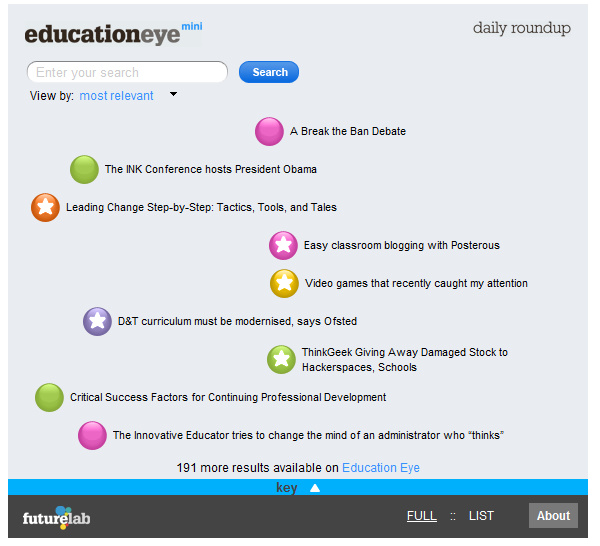
The Futurelab web site includes a mini ‘educationeye’ on the front page, but I couldn’t understand why the content was arranged as it was. Education Eye offers “a way to discover and explore new ideas by mapping 100s of the top educational websites, blogs, forums and practitioner case studies.” The list view was obvious, but the ‘full’ view positioned items around the space using some metric I couldn’t fathom.
Clicking on the title took me to the full version of EducationEye (http://www.educationeye.org.uk/) which I found took quite a bit longer to load. It has a fancy interface which allows you to scroll around and view articles relating to innovation in education. I’ve been back to look at this site a few times as it feels like it ought to be a really useful site, but the interface gets in the way for me. I feel like I don’t know what I’m meant to do with it. There is the option to subscribe via RSS, which seems more attractive as I’d be able to scan the incoming feed headlines quickly, but I feel like I’m missing something and being incredibly dense and failing to appreciate whatever brilliant design they’ve come up with.
General
The site initially appears easy to navigate with the front page displaying a large menu of 4 aspects:
When you click on one of these, you get an expanded list:
However, this annoyed me, as I wasn’t able to see the detail of what was under each menu item until I'd clicked on the front page link - and then waited for the page to re-draw. Maybe my broadband connection got busier while I was using the site, but it certainly took longer to load these pages than it had the home page.
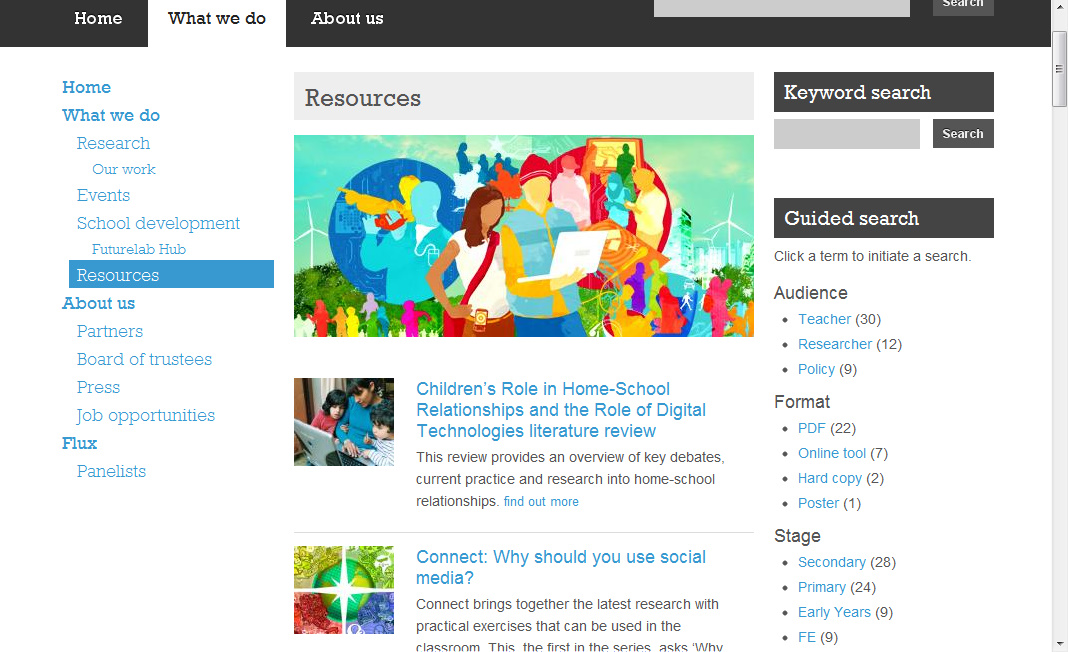
After quite a bit of fiddling, I found that the largest amount of useful looking content seemed to be on the Our Work and Resources pages. And then I discovered that the Resources page had a nice ‘Guided Search’ (effectively search by tag) feature... why wasn’t this on the home page?!
In terms of accessibility, I don’t know how a screen-reader would cope with this site. Perhaps the very simple top level of the menu would be easy for a screen-reader to interpret, but I don’t know how they work. I also don’t know how they work with Flash, but the interactivity provided by educationeye seems likely to pose problems for those with visual impairments.
I used the WAVE free web accessibility evaluation tool provided by WebAIM to check the site. WAVE doesn’t provide a complex technical report, but presents the original web page with overlayed icons and indicators that reveal the accessibility of that page. The outcome for Futurelab’s site seemed pretty favourable.
Academic
While this site deals with education, supporting teachers and providing resources, it is not intended to be a learning activity. Therefore, I didn’t really feel it was appropriate to evaluate in terms of pedagogical issues, learning design, sequencing, etc.
Context-specificGiven the intended audience, it might be argued that this site is designed for the technically confident, IT literate user, happy to use the tools available, knowledgable in search techniques, and able to easily recognise the web 2.0 features such as a blog and RSS feed. Conversely, the site could be intended to be for all those educators out there who really want to improve their innovative use of technology in learning, but who are nervous or lacking experience. I think that once they’ve found the Resources page they may be happy, but I feel that the navigation might put some people off - there is often a very real attitude (or at least learned behaviour) that if an item isn’t clickable from the front page, people don’t/won’t go digging for it. This makes web design a real challenge - providing readily available content, without completely cluttering up the front page.
Personal reflectionI have a niggling gut feeling with this site that, while it has good content and I think what Futurelab do is really interesting, the site itself feels like an example of design over substance. I feel that I shouldn’t be saying this... that they are a site focusing on technology in education, they know about design, accessibility, usability, they employ expert designers, and so it must be me who is wrong in not getting on with this site as well as I want to... but maybe, just maybe I’m not the only one?!