Showing posts with label Core activity. Show all posts

Saturday, 2 January 2010

Blogging in education

The use of blogging for education has had substantial take-up - Edublogs alone hosts more than 400,000 educational blogs, and there are many more with other hosts. What began as a tool for users to post their commentary within a chronologically displayed template has now been developed and extended to support a range of educational uses, including:

[from http://supportblogging.com/Educational+Blogging]
  • Teacher communication (to students, parents or other teachers)
  • Dialogue Generation (where the teacher posts questions about current learning, and the students may respond through the comment facility or their own blogs)
  • Student Blogs (may be public or of restricted visibility, allowing students to communicate their ideas and receive feedback through comments)
  • Teacher Blogs (to share resources, philosophies or methodology, to reflect on practice)
[from Educational Blogging - EDUCAUSE Reveiew]

  • As replacements for standard class web pages
  • To link to Internet items that relate to the course
  • To organize in-class discussions
  • To organize class seminars and to provide summaries of readings
  • Students may be asked to write their own blogs as part of their course grade

Duffy & Bruns (2006) divide the uses of educational blogs into academic, organisational and pedagogical:

"Within a personal academic perspective a blog can support:
• reflection on teaching experiences
• categorised descriptions of resources and methodologies for teaching
• ramblings regarding professional challenges and teaching tips for other academics
• illustration of specific technology-related tips for other colleagues.


Within an organisational perspective a blog can support:
• a common online presence for unit-related information such as calendars, events, assignments and resources
• an online area for students to post contact details and queries relating to assessment.


Within a pedagogical perspective a blog can support:
• comments based on literature readings and student responses
• a collaborative space for students to act as reviewers for course-related materials
• images and reflections related to industry placement
• an online gallery space for review of works, writings, etc. in progress, making use especially of the commenting feature
• teachers encouraging reactions, reflections and ideas by commenting on their students’ blogs
• development of a student portfolio of work."

[Duffy & Bruns (2006) The Use of Blogs, Wikis and RSS in Education: A Conversation of Possibilities]

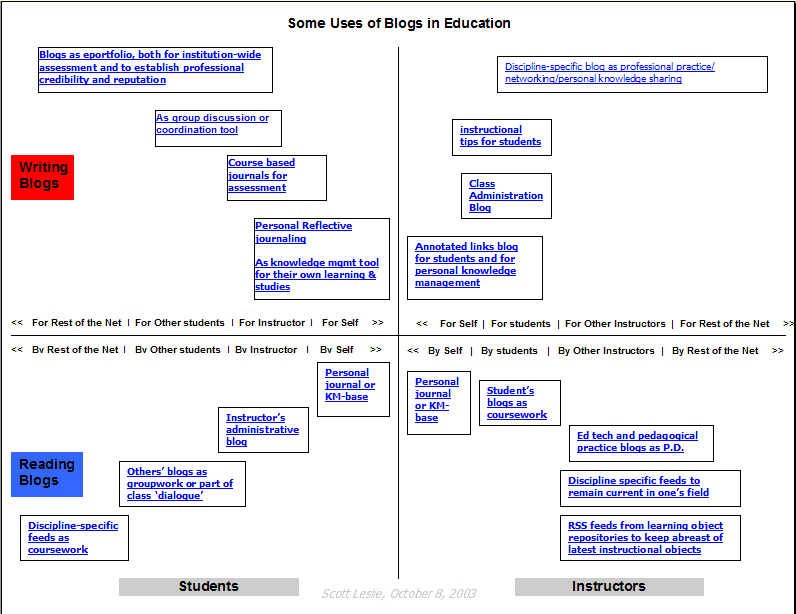
To consider the variety of uses of blogs in education, Scott Leslie of edtechpost.ca devised a matrix of some of the possible uses, including considering blogs written or read, by students or instructors, written for themselves, for their instructor/students, for their peers, or for the rest of the net. You can find Scott's matrix here, although note that he doesn't consider it a complete list as it doesn't include blogs by institutions or educational support staff such as librarians.

The benefits cited are many, including:

• promote critical and analytical thinking.
• promote creative, intuitive and associational thinking (creative and associational thinking in relation to blogs being used as brainstorming tool and also as a resource for interlinking, commenting on interlinked ideas).
• promote analogical thinking.
• potential for increased access and exposure to quality information.
• combination of solitary and social interaction.
[Fernette and Brock Eide, cited by Will Richardson (2006) in "Blogs, wikis, podcasts, and other powerful webtools for classrooms", in Duffy & Bruns (2006) The Use of Blogs, Wikis and RSS in Education: A Conversation of Possibilities]

* foster the development of a learning community
* give students ownership over their own learning and an authentic voice
* gives students a genuine and potentially worldwide audience for their work
* helps students see their work in different subjects as interconnected and helps them organize their own learning
* teaches a variety of skills

[Stephen Downes in "Why Use Blogs In Education"]

* helps students find a voice
* Creates enthusiasm for writing and communications
* Engages students in conversation and learning
* Provides an opportunity to teach about responsible journalism
* Empowers students

[supportingblogging.com]

* to support critical reflection
* to develop community of pracitce

[Yang, S.-H. (2009). Using Blogs to Enhance Critical Reflection and Community of Practice. Educational Technology & Society, 12 (2), 11–21]


Core activity 9.1 calls for me to define a maximum of 6 categories which address the range of blog use in education. The lists and links above show that blogging has been embraced and absorbed into educating in such a way as to make a small set of categories quite a challenge. I have attempted to include the range with the following set.

Pedagogical uses
This covers blogs provided by instructors of tutors in order to support their students, to provide activities or resources for coursework, or to develop collaborative work environments for their students. An example of this is Street Math 101, which provides support for a particular group of maths students.

Sharing and commentary
This may be by and between educational professionals (and any other interested readers). For example, many like to share useful resources they have discovered, or ask questions and advice about tools or methodologies they are trying, such as EdTech Tools which "celebrates all the latest gadgets, gizmos and good old-fashioned new technologies that are helping to move education forward".

Others comment on news or issues around education, such as Kapp Notes which discusses issues concerning learning, e-learning and the transferring knowledge from retiring baby boomers to incoming gamers.

Student owned
Student owned blogs in themselves have a variety of uses, including learning logs, reflections on learning, development of an ePortfolio, or as a place to complete or store course activities. Examples include Jan's blog of her OU MA (and more) learning Nick Delzotto's Eportfolio Blog, or Emma's PGCE Reflections.

Organisational
Some blogs offer a public face of an institution, or may be maintained by other educational support services such as libraries. Some organisations may use their blog to promote news, events, recent publications, or to stimulate debates, for example Flux by Futurelab.


Issues with blogging for education
Alongside the range of uses of blogs, there are a range of issues, both pedagogical and technical.

Pedagogical issues:

Commenting function - This allows students to obtain feedback on their work, or commentators to engage in debate. However, allowing completely free public access to comment on blogs may be inappropriate for some users (particularly minors), and a careful line needs to be drawn between getting value from the wealth of knowledge of potential commenters, and protecting the privacy or tentative early steps of a noivce blogger.

Caveat emptor - Blogs are not generally submitted to rigorous review or editorial control. Therefore, while content may be good, readers need to consider the validity of any comments contained in them. While on some blogs with many followers dubious or incorrect statements may be highlighted by comments, for many blogs there will be no critque or correction or content which may be lacking in some respect. From a pedagogical perspective, learning to select and appraise sources is an important skill for students to develop when they read public blogs.

Plagiarism - If you post model answers online, even after an assignment, they are open to be copied and used by others. While many institutions make use of plagiarism detection software, with the extent of the current blogosphere it's infeasible to consider that all deliberate or inadvertent plagiarism will be detected.

Technical Issues:
Tools - There are lots of tools out there which make writing a blog easy - at least the technical part of it! You still have to come up with the content :-)

Maintenance - Blogs typically grow and grow, with old material archived but available. As new ideas, syllabi or emphases for learning develop, old stuff needs to be actively removed if it is not to confuse or conflict with the current material. This contrasts with the situation with teachers' paper based materials, which are generally not available to students after use.

Access - Assumes all can access the educational resource that a blog contains. Universal internet access is not yet a reality.

Privacy and security - Internet security and safety concerns are well publicised. Bloggers need to consider their posts to ensure they do not compromise their identity or physical security. Particular safeguards should be in place when blogs are set up as part of a curriculum for children.


Further reading

As ever with the web there is a massive amount of potential out there...
If you're searching for educational blogs, the choice is overwhelming, but hopefully you'll find something in whatever flavour your prefer in blogged.com's Education directory, or blogcatalog.com's Academic, Learning and Educational blogs list.
 

Thursday, 31 December 2009

Podcast Review - Jan Moreland on using wikis for teachers' CPD

Core activity 8.3 was to review a podcast produced by a course colleague in a recent activity. I selected Jan Moreland's recording, which is available in Jan's blog post: Using wikis for reflective practice. Jan taks about how her school has used wiki technology in an effort to encourage reflective practice amongst school teachers. 

Sound quality
The recording was very clear, without background noise or distortion, and Jan's voice was measured both in pace and volume, which made it easy to follow.

Broadcast quality
Jan spoke clearly on her subject without hesitation or repitition, and it was evident that she had carefully thought through the content and progression of her recording.  It was well constructed - I found the introduction sentence at the beginning, telling me what was to come, particularly useful, and that the couple of requests for comment and feedback were well-placed, particularly given the subject matter of CPD.

Suitability
The audience for this podcast were other H808 participants, but Jan's blog makes her work more widely available. The clarity of her explanations means that this work will have wider value to other educational professionals, as well as being understandable by those who are perhaps less familiar with teaching and CPD developments.

Length, interest and engagement
3 and a half minutes. This looks short when I write the length, so I was impressed at the scope of content that could be included in a short piece, without it being hurried or excessively brief. Jan made, expanded and developed several points, and held my interest throughout. I would say that the length was appropriate given the task, but I would happily have listened to a substantially extended debate - the subject matter was interesting and is deserving of further discussion. Perhaps when TMA deadlines are out of the way! 

Academic quality and suggestions for improvement
This piece is based on some action research Jan has completed, and also includes several points which she offers as her opinions. I feel this is a nice balance. Jan mentions at the beginning of the recording that she will refer to a journal article by her, but I felt that this was then not very clearly referenced in the rest of the piece - I couldn't quite tell which parts of the recording related to the journal, and which were views only in the podcast. I'm sure the article provides an interesting extention of the content in the recording, so given an opportunity to record a more substantial piece this could be included. However, for the purposes of the H808 task the recording was fine - I'm just interested and so would like to be able to hear/see more another time!

Suggestions for use
This recording discusses the successful steps taken by one school to develop their CPD programme for teachers. It will provide useful suggestions for others looking to develop their CPD offerings, or for those interested in the use of wikis. Jan's requests for suggestions to improve their practice using wikis also mean it could also offer a nice context for a CPD brainstorm on successfully developing wiki use.

Wednesday, 30 December 2009

Exploring Teleplace

Activity 8.1 is to engage with a new technology, consider some of its key features in relation to my own educational practice or context, and identify potential issues for other users. One of the focuses of my practice is the investigation of virtual work spaces for distance learners. For this reason I selected to explore Teleplace. Teleplace describes itself as "an intuitive environment for distributed teams to communicate and collaborate on multiple applications and documents in real time" (http://www.teleplace.com/).

This post has 3 parts. Firstly, a learning log of my interactions with Teleplace, secondly, some thoughts about its features, and its use for education and training, and thirdly, the identification of some issues which may affect other similar users.  

Learning log

1. I first spent a bit of time looking around www.teleplace.com, reading FAQs, etc
2. Googled for Teleplace and education to see what other practitioners are doing/recommending/commenting (found very little education-related content specifically for Teleplace (as opposed to virtual worlds in general)
3. Signed up for a free 30 day trial - simply clicked link on Teleplace web site, filled in my details, and I was taken to a page with my login and download credentials. User name, password and download links were also emailed to me.
4. Download of the installer opened automatically. Download on ordinary broadband line took about a minute.
5. Installed - very simple. Setup wizard steps you through agreement to EULA, and install location choice. Took about 5 minutes to copy all its files, but no intervention from me needed. At end of install, click Finish to launch Teleplace.
6. Logged in using name and password from registration email.
7. This takes you to the 'Lobby' - the list of available Teleplaces: 'Project', 'Reception' and 'Training-Center'. There is also a list of templates available to help quickly build spaces like a library, conference room or office. I opted for the Reception as the list of contents (right of the Lobby window) showed documents were included which sounded helpful - Adding Your Stuff, Welcome, Your Appearance, etc. I clicked on Reception and then Enter Teleplace.

8. The Reception area started up with a Welcome slide show, which I went through. This included the purpose of various information panes in Teleplace, seeing who's 'in' the Teleplace, navigating to landmarks, movement using the keyboard, mouse and shortcuts, and links to further orientation information.

The Reception area includes a number of poster boards with basic information. I followed these (there were arrows between them) , taking me through 'Your Appearance', 'Adding Your Stuff', Sharing Applications', and 'Get Together' (about inviting colleagues).


9 - I then spent about an hour using the templates to create rooms (Teleplaces) and add tools to them.
In that time (and it would be much quicker a second time!) I created 2 rooms which include tools (some already in the rooms, some I added) such as:
  • a timer - set it going to keep track of time working on a collaborative activity
  • a feed reader - currently collecting BBC news
  • a whiteboard
  • a brainstorm wall with sticky notes/topic discussion cards
  • a Word document for shared online editing, or for saving local copies to work offline
  • a screen projecting a pdf document
  • a dropbox - where files imported to the Teleplace go if you're not in the place at the time
  • a wall clock showing current time
  • an auditorium with elevator to group working tables
  • a library with shelves on to which you can add/remove documents
  • break out work rooms
  • web browser with live web page
  • a tabbed wall - add notes to multiple topic threads in one location.

Other facilities, some of which I have explored:
  • You can connect new rooms on the fly by simply dragging them on to a teleport door.
  • Functions included for meetings including lead a meeting, tally a question, restrict movement of others in meeting
  • Individual and group chat possible - chat is bounded by walls
  • Built in VOIP - I didn't require any configuration, simply plugged in my headset, and was away
  • Web cam integration
  • Text chat - private chat
  • Video conference integration
  • Ability to record sessions and take screenshots
  • List of available Teleplaces for instant teleport, or walking around by arrow keys
  • Customisable avatars
  • Transcript of actions
Features for elearning and distance learners

The above list of functions and tools obviously offers plenty of potential for Teleplace as a learning environment. However, technology alone does not provide effective learning, so I have attempted to consider possible uses of these features.
  • Mentoring - a secure personal space for mentor and mentee to meet and work together. Private rooms can be used, or conversation can take place in 'public' areas. However, this is not a public 'world' in the Second Life sense - a Teleplace is set up by an organisation, and is only accessible to those who are granted access by invitation.
  • Formal training programmes - as an alternative to classroom environment, or as a groupwork space for dispersed students.
  • Social space - a 'cafe' type space for dispersed students to meet up with others - sort of like a message board or forum, but with greater flexibilty. This could help support group cohesion and interaction outside of core activities, and reduce some of the isolation of being a distance learner.
  • Group collaboration - use interactive applications (e.g. Word, Excel, web browser) to work on a document at the same time as others. Use a laser pointer to highlight key aspects. Simply drag documents from your PC desktop/file structure onto a document viewer in Teleplace. You can then leave documents there for others to use even after you have left the Teleplace, or keep control of them and 'take them with you' when you log out.
  • Recording - classes/interactions can be recorded, allowing for post-training analysis or archiving. This could facilitate the instructor's PDP, support student revision, or be used in developing and refining courses for subsequent presentations.
The key to Teleplace's power to me seems to be that it is ready to use out of the box. It includes templates for all sorts of pre-built spaces (e.g. office, conference room, library, ouside terrace, fields, reception hall, etc). These can be selected for use with very few mouse clicks. Similarly, all the tools can simply be added to the space by mouse clicks. No programming or scripting is required, and no graphics expertise is needed to construct the environment. That said, for those who do have their own environment/building models, these can be imported into Teleplace, allowing role-play training or orientation and safety training to be delivered in a 'mirrored' environment. I haven't gone so far as to explore this feature though.

Issues
  • Beyond the 30 day trial this isn't free. Pricing depends on the number of users, but is in the region of $50 per user per month. Once the 30 day trial expires, any spaces developed are lost - collaborative work in documents can however be downloaded back to users' individual PCs, and so is not lost.
  • Virtual environments are not for everyone. Some people will be happy with existing text-based chat or email collaboration methods.
  • Like all internet based tools, users will need sufficient bandwidth for operation, particularly VOIP/conferencing. It would be sensible to check requirements and users' computer specifications before any activity in order to prevent frustrations or delays once a collaborative activity has begun.
  • The avatar movement is 'clunky'. This might irritate some people, although others may feel that the avatars are just a function for positioning your viewpoint in the Teleplace, and realistic movement is not a requisite of effective collaboration.
  • Teleplace, like other virtual environments, offers many options for teaching and learning, including instructor led, explorative, constructivist and self-paced formats. The elearning practitioner developing learning in Teleplace needs to understand the available range, and know how to select an appropriate pedagogy.

Saturday, 28 November 2009

Differing professional values

In this post, for activity 7.1. I explore the professional values mentioned by the Association for Learning Technology in the CMALT prospectus, by the Higher Education Academy, and by several other professional bodies.

The ALT's CMALT prospects specifies a surprisingly limited list of only four values:
  • Commitment to exploring and understanding the interplay between technology and learning
  • Commitment to keep up to date with new technologies
  • Empathy with and willingness to learn from colleagues from different backgrounds and specialisms
  • Commitment to communicate and disseminate effective practice
While the document does mention in passing "taking a committed and serious approach to professional development" and "critical reflection on practice, achievements and expertise", (and therefore implies that these are also professional values), I found it surprising that these aspects were not made explicit, and that while it is mentioned that CMALT will allow you to demonstrate these attributes, they are not an underlying principle.

The professional values expressed by the UK Higher Education Authority are:
  1. Respect for individual learners 
  2. Commitment to incorporating the process and outcomes of relevant research, scholarship and/or professional practice 
  3. Commitment to development of learning communities 
  4. Commitment to encouraging participation in higher education, acknowledging diversity and promoting equality of opportunity 
  5. Commitment to continuing professional development and evaluation of practice 
Point 5 here makes clear the value of commitment to professional development. There are further notable differences between the ALT and HEA's value statements. I found it particularly striking that the ALT makes no mention of values which directly involve learners. While it is a society of technologists, there is a need to understand the learners for whom they develop technology, and I feel that learning technology professionals ought to have a professional commitment to students, whether or not they work directly with them. Stemming from this need I would also expect a learning technologist to have an understanding of educational or pedagogical principles, and hence a value of commitment to appropriate understanding and application of these principles.

Interestingly, neither the ALT or the HEA make any reference to ethical principles or standards, and consequently there is no comment on procedures if such standards are not met. There is also no mention of quality, or the aspiration towards it, for professional knowledge, application or behaviour.

Other organisations, such as the Institution of Engineering and Technology (IET) provide more detailed codes of conduct. For example, the IET has 22 rules of conduct, each of which are underpinned by one or more of 8 principles (honesty, integrity, fairness, confidentiality, competence, objectivity, environmental sustainability and health, safety and risk).

It is possible that the less prescriptive approach of the ALT and HEA are indicative of a teaching profession which has (until relatively recently) had considerable freedom in its own organisation. Conversely (and in particular for the ALT), it may be considered unsurprising that a fledgling profession (if indeed it is one) has not yet established the depth and rigour that underpin professions such as engineering or medicine. However, the fundamental principles such as honesty, integrity and fairness, as exemplified by the IET's code of conduct, might be considered to be universal, and so should be expressed somewhere.

Some organisations, such as the IET or the British Association for Counselling and Psychotherapy (BACP), have a value set which further illuminates the key activities of the profession. For example, the BACP values include a commitment to:
  • Respecting human rights and dignity 
  • Ensuring the integrity of practitioner-client relationships 
  • Enhancing the quality of professional knowledge and its application 
  • Alleviating personal distress and suffering 
  • Fostering a sense of self that is meaningful to the person(s) concerned 
  • Increasing personal effectiveness 
  • Enhancing the quality of relationships between people 
  • Appreciating the variety of human experience and culture 
  • Striving for the fair and adequate provision of counselling and psychotherapy services. 
By contrast, the ALT's only values which make clear their professional activities are commitment to exploring and understanding the interplay between technology and learning, and to keeping up to date with new technologies. It seems that there is much left unsaid in these statements about what learning technology professionals do. Perhaps this is again due to the relatively undefined nature of the profession, and to the fact that it incorporates many roles. In fact, the ALT themselves acknowledge this in their statement that "values and codes of practice differ from institution to institution, discipline to discipline, role to role, and may evolve through time". It is therefore perhaps understandable that their listed values are not as prescriptive as more defined professions, but I fear that this lack of coherence may hamper attempts to become a recognised profession.

Friday, 20 November 2009

Case study: Documenting student learning in outcomes-based education

Core activity 6.2 requires us to browse through some of the case studies from the Carnegie Foundation's Gallery of Teaching and Learning uses of the KEEP Toolkit. We need to find one or two examples where the claims made for benefits to learning are particularly convincing (or otherwise), prepare a brief comment on these cases and post to our group.

Case study: Documenting student learning in outcomes-based education 
The School of Information Technology and Communications Design, CSU Monterey Bay uses a series of Major Learning Outcomes (MLOs) as core requirements for graduation. MLOs are physical proof and example of knowledge gained on a course, and starting in Spring 2004, students used the KEEP Toolkit to produce an eportfolio page demonstrating the MLO evidence.

Goals:
  • To encourage students to document and reflect upon their learning experience
  • To make this knowledge explicit to themselves, their instructors, their family, and their prospective employers.
Key principles of practice:
  • Promoting reflection on learning
  • Allowed tutors to provide prompt feedback and guidance to deeper student reflection
  • Developing a record of ones learning experience
  • MLOs clearly communicate expectations and outcomes 
  • Acknowledges the value of collaborative learning and sharing information freely
  • Encourages students to demonstrate developing competencies over a period of time, allowing students to map progress
Would you recommend this case study for the presentation?
Includes links to 3 excellent eportfolios, and covers a range of practices, so I would recommend this one for the presentation.

Thursday, 12 November 2009

Professions and professional values - Warrior

The second part of core activity 5.1 was to read Warrior's ‘Reflections of an educational professional’ and to use her thoughts on education as a profession to in framing my own thoughts with regard to elearning. Here are my own preliminary and brief definitions of ‘profession’, ‘elearning’ and ‘elearning professional’ based on the reading

Professionals and professionalism

I read Warrior, and found it triggered some useful thoughts on professionals and professionalism. I felt she got a bit lost at the beginning. I think the question of a professional as someone who is paid (as opposed to an amatuer, who isn't) was a bit of a diversion, as was her discussion of gender discrimination (which might be all correct, but had little to do with the core subject). Once she got going, however, she introduced a number of key concepts and ideas about what a professional is.

I won't comment on her thoughts one by one, but rather give my thoughts that were triggered through my reading of this and other sources.

In my mind, being a professional is related to the following concepts:

Personal initiative - a professional has to be able to make their own decisions and decide courses of action, based on their own knowledge and experience.
Independence - a professional should be trusted and is expected to exercise their own judgement.
Personal responsibility - A professional has to be liable for and takes responsibility for decisions made, and can't hide behind rules and regulations.
Recognised training - a professional will have completed formal, certified training, recognised both formally and by the wider public.
Recognised development path - professionals have a recognised path (or paths) through training, experience and certification.
Experience and career development - professionals demonstrate commitment to a long term career. You can't be called a professional just because you have passed an exam.
Maintenance of skills - a professional is expected to maintain their knowledge of their domain and their skills in working within it.
Paid - I don't think you can have unpaid professionals (although they may do specific activities for nothing, or "pro bono").
Institutional membership - every profession has a recognised national or international body that both represents the collective views of the profession, and is concerned with professional standards and behaviour.
Quality - a professional does high quality work.
Dedicated - professionals are seen as committed to and believing in what they do.
Status - a profession is not a profession if its status is not recognised and respected in the wider community.

As I thought through all this I found it interesting to compare a professional with an expert, a craftsman or a specialist.

You can be an expert in a subject or a domain, without being a professional. You may not work in the domain, you may not be able to hold a position of responsibility, you may not have broad enough expertise (which might make you a specialist) or it may not be in an area recognised as being professional. (By contrast a professional may also be an expert and a specialist)

A craftsman is to be admired for his or her skill, but professionalism is also related to making wider decisions and exercising initiative beyond an object or artefact.

So, after all this wandering, I found it hard to put together a precise definition, but here goes:

A Professional is an individual, recognised for their knowledge and skill in a particular field, and trusted to use their initiative and experience to make important decisions within their area of competence. They will have undergone extensive training in their field, and be certified by a widely recognised national or international body.

elearning

Literally, elearning is learning through electronic means. By extension, we can think of elearning as the wider domain concerned with supporting and conducting learning through electronic means.

Interestingly, I don't think you'd talk about "an elearning student", and we don't call someone who teaches using electronic means as an "eteacher" or an "elearning teacher". So that narrows down the definition to:

Elearning: the theory, practices, processes, technology and people that facilitate student learning through electronic means.

elearning professional

Based on the above definitions, we should be able to say that an elearning professional is a professional whose domain of expertise and work is elearning, and who also meets the other criteria for professionals listed above.

Unfortunately that would mean that right now there are no elearning professionals in our new and developing domain. We currently lack a widely recognised professional organisation (although some are developing, such as the Association for Learning Technology) and there is no recognised career path that would differentiate between a professional and a well trained expert.

At present there are certainly professionals (educationalists, chartered engineers, academics, etc) who also are experts in elearning, and who work in the field, but that isn't quite the same.

Perhaps right now we are studying to become the next generation of elearning experts, and once the discipline has matured, and the supporting scaffolding of a profession has been built and recognised, we will be able to join the first wave of elearning professionals.

Warrior, B. (2002) ‘Reflections of an educational professional’ (online), Journal of Hospitality, Leisure, Sport and Tourism Education, vol. 1, no. 2

Professions and professional values - Perkin

Core activity 5.2 first required us to read the chapter by Perkin and write a short comment (maximum 500 words) on whether we think his view of modern society is justified, and also to compare Perkin’s view with alternative descriptions of modern society that you are aware of – for example, the ‘information society’

I found the Perkin paper a fascinating politico-socio-economic piece, but  struggled to draw from it too much about professionalism, or the values that entails. I also found it hugely challenging to read and critique, mainly because it is outside my normal sphere of understanding.

My main concern was the age of the paper - 1996 - and thirteen years on I feel his view is no longer justified. Things have moved on enormously since then, in particular due to the internet and the array of knowledge and information dissemination pathways which this has spawned. With this ready access to vast amounts of information, many people and businesses no longer require professionals to provide this knowledge. Obviously expertise and analysis remain valuable, and information always requires interpretation and application, but I suspect the role of a professional as Perkin considered it is changing.

Perkin argues that the terms professional, professional expert and professional expertise should be taken in the widest terms - including the tradional professions, but also 'professional bureaucrats' and 'professional managers'. This aligns with Sockett's definition of a profession as "an occupation with a crucial social function, requiring a high degree of skill and drawing on a systematic body of knowledge", but less with Millerson's "closure of the profession by restircitve organisation" or Lindop's " standards that are publicly acknowledged".

Perkin's wide view of professionals as an elite in a specialised-service based economy seems to echo the initial definition of the information society as a "society in which the creation, distribution, diffusion, use, integration and manipulation of information is a significant economic, political, and cultural activity" and where "the knowledge economy is its economic counterpart whereby wealth is created through the economic exploitation of understanding". However, please note that these are Wikipedia definitions, which is my current level of understanding of the meaning of the 'information society'!

It could be argued that today we are moving beyond Perkin's Third revolution, into another where the professional has a different role. The information environment has shifted radically with the internet giving access not just to formal resources, but to a mass of informal information in blogs, web pages, videos and pictures. It is in this new environment that elearning professionals will have to operate, no longer the guardians of specialist knowledge, but rather guiding students through a chaotic and ever changing world of information.


"The Third Revolution - Professional Elites in the Modern World". Harold Perkin (1996), Routledge.

eLearning and professional development

Core activity 5.1 was to explore a number of websites looking for implicit and explicit definitions of elearning professionals, and then to consider how far the areas of professional development contained in H808 so far have been in line with what is going on elsewhere in the elearning world.


Clearly so far in H808 we've looked at eportfolios, reflection, PDP, and development of technical competencies. These are all related to developing skills to be both a successful learner and successful elearning professional (and presumably H808 students aspire to be both). In my exploration of the suggested websites I felt the focus was less on technical skills, and more on the development of communities of practice, accreditation and on the development of competencies particularly for (possibly predominantly )classroom-based teachers and trainers. I think this perception of difference between H808 and the elearning world based on focus on technical skills being a key part of this course is actually mistaken, as I see the technical elements as being included in order to explore the pedagogical principals they support.

The consideration of what it means to be an elearning professional (elsewhere in Unit 5) aligns very well with the variety of terminology that is out there. While I found none of the suggested websites attempting to define 'elearning professional', the scope of what was included (e.g. administration, facilitation, instructional design, teaching, content authoring, mentoring, learning system production) goes some way to illustrating the breadth of the term. Perhaps H808 is pushing boundaries and asking difficult questions by trying to define what we mean by elearning professionalism. Some of the websites certainly don't seem too questioning (e.g. The eLearning Guild, which appears anyone can join if you want to pay up), whereas others have more stringent conceptions of professional development and maintaining competence (e.g. CMALT, membership of which requires assessment by your peers and experts, with periodic updating). Certainly the questioning, reflective attitude promoted by H808 appears to be one cornerstone of professionalism on which the more rigorous websites (CMALT, EIfEL etc) are agreed.


Wednesday, 21 October 2009

Multimedia as evidence

Core activity 4.1 - How can you create and store evidence of your engagement in the following types of activity on H808?
  • Contributions to online discussion
  • Personal blog postings or comments on others’ blogs
  • Contributions to the course wiki
  • Notes and informal reflections written by hand
  • Examples of formal writing (TMAs, reports, etc.)
  • Extracts from PowerPoint presentations
  • Extracts from audio presentations
  • Extracts or screendumps from websites or video presentations
  • Comments from peers and tutors
  • Extracts from published sources (images, newspaper/magazine stories etc.).
The following map is multimedia evidence in itself, created with Mind42, a free, online, collaborative mind-mapping tool.You can drag the map around to view, zoom using the slider, or select the node level to focus on.

Monday, 19 October 2009

Key features of eportfolio systems

Core activity 3.1 involved the comparison by each student of two (or more) eportfolio systems on about six of the features which they considered to be key. By aggregating the features selected by each student we can see which features (in our opinions at least) really are key.

Wordle gives a lovely visual representation of this.
Wordle: H808 Core activity 3.1 - key features of an eportfolio system

This post also demonstrates how a multimedia item may be used as an item of evidence of thinking (and technical skills) for an eportfolio (core activity 4.1).

Sunday, 18 October 2009

Personal and professional development planning

Core activity 3.4 required the adaptation of a PDP needs analysis grid for our own competency requirements, making self assessments against the required competencies, and development objective setting. My PDP grid is shared here.

This blog completes the activity with a reflection on what I have learned about my strengths and weaknesses as an elearning practitioner as a result of the activity.

I approached this activity with a little trepidation, well aware of the need to understand personal competencies in order to set development goals, but also conscious that people are often not very good at making accurate self-assessments (Boud & Falchikov 1989, Mitrovic 2001, Ward, Gruppen & Regehr 2002, Eva, Cunnington, Reiter, Keane & Norman 2004). Even after completing the activity, how do I know that my assessments are correct? I suppose one way would be to go down the ePortfolio route, assembling items of evidence against each competency - in fact, would this be a new use of ePortfolios (for assisting students' self-assessment - I'm not sure if I've seen that purpose before).

Given that people (myself!) may not be very good at self-assessment, I was also concerned about trying to make assessments to fit the given levels (Complete novice, Below average, Average, Above average and Expert). These seemed to me subjective, and therefore likely to make assessment all the harder. They also implied a comparison with others, whereas I felt my assessments of my competencies would be valid however they compared to others' abilities. Similarly, if self-assessments are likely to be inaccurate, how can I accurately assess the 'average' of a larger community?

I therefore found myself defining slightly more detail for each competency level, resulting in the following:

Complete novice

Limited knowledge / understanding

Some knowledge / understanding
Someone reasonably intelligent, with at least a general interest in eLearning. Perhaps able to use/do the competency, but not to analyse/critique/develop. Probably a base level for students of H808.

Good knowledge / understanding

As above, but with some experience, further study etc in this area of learning/technology.

High knowledge / understanding (expert)

Perhaps able to be an authority or have higher level study in this area, able to teach this element, have greater awareness of issues, practices, debates and resources.
Given these level definitions, I found it easy to consider how I related to each competency.

I think the most striking outcome for me is the distinction between technical aspects, where I score quite highly, and other teaching and learning aspects, where I am comparatively weak. This is not a huge surprise to me, given my background of Computing and Psychology followed by AI in Education research. I clearly lack experience in working with elearning students, and in developing elearning tasks, and these are aspects where I hope to gain first knowledge (from this and subsequent courses) and then real world experience.

I also found the objective setting element useful, and something I haven't done for a long time. This in itself is probably a weakness in terms of both my learning and my elearning professionalism. Useful to be reminded of the benefits.

References
D Boud and N Falchikov, “Quantitative Studies of Student Self-Assessment in Higher Education: A Critical Analysis of Findings,” Higher Education 18 (1989): 529-549.
A Mitrovic, “Self-Assessment: How Good are Students At It?,” in Workshop on Assessment Methods in Web-Based Learning Environments & Adaptive Hypermedia (presented at the 10th International Conference on Artificial Intelligence in Education, San Antonio, 2001), 2-8.
M Ward, L Gruppen, and G Regehr, “Measuring Self-Assessment: Current State of the Art,” Advances in Health Sciences Education 7 (2002): 63-80.
K. W. Eva et al., “How Can I Know What I Don't Know? Poor Self Assessment in a Well-Defined Domain,” Advances in Health Sciences Education 9 (2004): 211-224.
H851 Practice Guide 7, Reviewing and Improving your Teaching, The Open University, 1998, p.31.

Monday, 12 October 2009

Recommending an eportfolio system

The task for core activity 3.2 was to write a 500-word report aimed at an audience of managers in an educational institution or organisation of your choice (or your imagination), overviewing some available eportfolio systems and recommending one or more of them. It should provide information to help them decide which of the systems is best suited for their purposes*.

For this report I consider the selection of an eportfolio system for a scenario which draws on some elements from my work but which fictionalises a number of aspects.

The navy of a European country wishes to expand its training programmes using a range of distance and e-learning techniques. Among their requirements are the need for aneportfolio to:
  1. Record student progress on tasks to provide evidence for certification
  2. Record student actions in tasks for formative assessment
  3. Allow students to develop and reflect upon a record of their competencies for use in personal development planning (including identifying future training needs)
  4. Integrate with current systems including a VLE, and potential future systems such as synthetic training environments
  5. Accessible by mobile phone/handheld device
  6. Consider security of data - hosting should be by the client organisation.
The users of this system will be students/trainees (technical operators, such as maintenance technicians, service crews etc), trainers and assessors of these personnel, and senior managers with responsibility for ensuring training is delivered effectively. The trainees are familiar with operating complex computer-based systems, but training time for theeportfolio system should be minimal. Therefore after an initial familiarisation session, functionality should be intuitive and trainees should be able to use the system without assistance. This is also the case for trainers and assessors, but their interaction with theeportfolio system may be expected to be more restricted (focusing on accessing and commenting on presentations of evidence). Therefore, initial training for these roles may be focused accordingly, and should also allow users to rapidly reach a state where they interact with the system without support. The final user group (management) may be less familiar and adept at using new systems, and so views extracting the data required should be available.

The requirements given above lead to a number of possible system, dealt with here by requirement.

Requirement 1. All systems offer a way for students to record progress, although not all are tailored for assessment. eNVQ, Mahara, MyStuff and One File all support assessment or are particularly designed for it.

Requirements 2 and 3. These point to a need to support student reflection, and for others (e.g. tutors) to be able to offer formative feedback via comments.Mahara, MyStuff and PebblePad are particularly tailored to support reflective learning.

Requirement 4. The need to integrate with potential future (i.e. as yet unknown) systems is very open ended. Mahara can integrate with the Moodle LMS, and as it is open source, its code can be inspected to consider its appropriateness for future integration.

Requirement 5. Mobile access is necessary for trainees working in the field, and may be provided by MyStuff and PebblePad, but not currently Mahara.

Requirement 6. Mahara and MyStuff both offer the facility for the client organisation to host eportfolio data within their own secure network.

Given this analysis, an open source solution (Mahara or MyStuff, for example) may be most appropriate for a number of reasons:
  • Specific requirements mean current off-the-shelf solutions all have shortcomings
  • In-house developers are available to deliver a customised solution based on an open source system 
  • Unknown future requirements can be met by subsequent development.

* The full activity requirements were:
Consider the following issues:
  • the primary users of each system (i.e. higher education, schools, PDP, industry)
  • any unique or particularly desirable features from the point of view of the learner, teacher and organisation
  • the most appropriate system for this context, given the type of use you intend.
Conclude the report with a specific recommendation (which can include rejecting all of them).

Wednesday, 7 October 2009

Feature comparison of eportfolio systems

Core activity 3.1 - to produce a comparison grid of the key features of two eportfolio or eportfolio-type applications. Tutor group discussion of which features really are 'key' for an eportfolio system to follow.

Not able to display all table columns here... so please see this published Google Doc.

Saturday, 3 October 2009

Further reflections on core activity 2.4

This post returns to the task for core activity 2.4 - to post a comment to your blog reflecting on your own attitude to reflection in learning and on the usefulness or otherwise of blogging as a means of doing it. After completing the readings* for the task, I think my feelings about reflecting on learning, and using a blog as a tool for this are relatively unchanged from my previous post.

However, there are a couple of points/feelings/ideas that I noticed while going through the readings.

Firstly, I felt I identified with those students in Crème's work who would prefer a friendly non-judgemental reader than an assessor to view their reflections. My reflections feel personal, and while I'm happy with the purpose and practice of reflecting, it's the sharing for assessment that I feel is more difficult.

I also noted that the type of reflection I have been doing in these blog posts is more akin to the 'progressive journal' rather than ''reflective writing such as that used in professional courses where students have to relate theory to examples of their practice, a distinction noted by Crème. I think that this is probably ok for the current stage of the course, and my treatment of the blog as more of a learning journal. However, I think that I will have to undertake some more specific, directed reflection, in order to experience these techniques, to develop my abilities in them, and (not least) to meet the course requirements.

I have an ongoing concern about meeting all the criteria for the course assessment. There seem to be many, and I feel that there is likely to be a conflict between honesty and personal investment, and the need to meet assessment requirements in a systematic way. Hopefully the OU's careful development of criteria, designed to assess the development of reflective skills which actually be an enabling factor which may allow me to feel confident that I have conducted an appropriately comprehensive reflection.

A couple of other slightly unrelated noticings and reflections...
- I found reading the papers much easier because I had specific information which I wanted to extract from them, rather than just gain a general understanding
- Pointing our activities to blogs and forums means I am seeing others approaching the tasks differently. This is good and bad. It raises anxiety that I am not doing it right, or am interpreting it wrongly if I approach things differently to others. Equally, seeing these differences between our approaches helps reinforce the recognition of our diversity of backgrounds, expertise, interests and interpretations - and that fact that a varitey of contributions are both interesting and valuable.

[Readings were:

Friday, 2 October 2009

Reflecting on reflection - towards activity 2.4

Core activity 2.4 involves reading several papers on reflection, considering their relation to the OU's methods of assessing our development of our reflective skills in this course, and asks for a blog post reflecting on your own attitude to reflection in learning and on the usefulness or otherwise of blogging as a means of doing it.

I thought I'd write a few notes on my own attitude to reflection here, before I read the papers, to see if my feelings change after reading.

At the moment I'm not too sure what I think. Reflection feels hard - especially when it's a required task. I feels that it comes more easily when it's spontaneous... such as when I begin by thinking about a technical concept, but unintentionally diverge in asking why, and how and what this means for me. This type of organic, unstructured reflection has certinaly made me think in ways I otherwise wouldn't have, but I'm not sure it's the best way to undertake the reflection for this course - that needs structure, and I think that's one aspect of the 'professionalism' of the course title.

Having just reread the course and assignment guides, and their comments on assessing reflective writing I feel that I will have to reflect in a very specific, directed way in order to achieve in the course. This isn't, in itself, good or bad, but it may have different outcomes to if it were spontaneous.

I've certainly done more reflection on this course, its contents, and my own learning because I've been writing blog posts, so in that sense, for me,blogging has been useful. Had I not been writing the posts, I strongly suspect the reflection would not have occurred to such a degree. However, I do note that I am conscious that there is an audience for a blog post. I don't attempt to write for them (they can always choose not to read if they're not interested), but I do feel that I censor, re-work, or re-phrase my writing because I know people are reading. If my blog were private, which it could be, then the outcomes may be different - although I don't know in what way or to what degree. I may try a few bits of reflective writing not in the public blog, and consider afterwards whether I want to post them, just to see if there's a difference. However there will be a conflict as I want to post as much on the blog as possible, and if I start feeling the need to re-write some work for public viewing then I'm going to run into serious time problems. It might be that this re-working and re-phrasing is actually a further level of reflection in itself, or perhaps it's just editing, during which the piece might lose its initial honesty.

I think I'm particularly concerned about the course's requirements to relate content to your own professional practice. Given that I'm not currently in an e-learning role (and that the course requirements stated that you didn't have to be), this is going to be difficult for me. I can speculate on how I would (hopefully will) apply what I've learnt, but it's difficult without a context to relate it to. I think this adds to the anxiety about doing the 'right' sort of reflection to pass the course, which may not necessarily be the same reflection that is natural to me. However, being prompted to think outside my comfort zone will almost certainly be valuable to my development, so it's welcome in that respect.

[Thanks are due to Hazel, Isabel and Madeleine here... this post was going to be a private one, but their comments in the tutor group forum have helped me realise I am among friends, and safe to post here (ignorring all the billions of internet users who fortunately don't read this!)]

Thursday, 1 October 2009

‘e-portfolios’ by George Siemens (2004) - a summary

Core activity 2.3 was to write a summary of the issues raised in en eportfolio paper. I selected ‘e-portfolios’ (Siemens, G. 2004) Available from: http://www.elearnspace.org/Articles/e-portfolios.htm 

This short paper (only 5 pages) provides a balanced and considered overview of eportfolios, including definition, influences, benefits, comments on the creation process, issues, tools, trends and implementation needs.

Siemens makes the argument that portfolio implementations can be viewed as a continuum, that is, that they are driven by the task (either "assessment, PDP, learning portfolio, or group portfolio"). This makes sense: given the many and varied definitions and conceptions of eportfolios, the argument that "the intended task of the portfolio is the ultimate determinant of value" goes some way to explaining why eportfolios are many things to many people. Siemens also argues that, regardless of the format selected, eportfolios should encourage learners to develop the skills to continue building their portfolio as a life-long learning tool. This relates to one of the anticipated outcomes of using an eportfolio identified by this paper, namely that in a knowledge economy the ability to express knowledge effectively improves one's opportunities for employment and access to education. This does however assume that that learners will be motivated to develop a portfolio, and see value in maintaining it beyond compulsory education - something which is far from guaranteed, and which Siemens doesn't really address, except for a single sentence in his conclusion.

Siemens suggests a number of benefits that learners may receive from using an eportfolio to reflect on their experiences. Crucially, he sees eportfolios as a skill for lifelong learning. He suggests that eportfolios support this through (amongst other things) their ability to incorporate artifacts from informal learning and learning through life experiences. Siemens considers that this offers learners personal knowledge management and a history of their development and growth. Perhaps the most powerful benefits to learners identified by Siemens are the use of eportfolios as a planning/goal setting tool, as assistance in making connections between their learning experiences, and in providing the metacognitive elements necessary to assist in planning future learning needs. However, he does not articulate how an eportfolio will achieve these (not insubstantial) aims. My feeling (not yet supported by research evidence) would be that the eportfolio can be a tool in supporting these goals, but that they are processes undertaken by the learner which need support to develop, may require training, and certainly the opportunity to practice. Reflection is often not an easy or natural process, and simply having a tool available will not automatically make the benefits available to learners.

Siemens makes a number of interesting comments on implementation challenges. Unlike some others (refs?), he considers that the "standardization of eportfolios is a potential challenge" and that regulation may stifle creativity and innovation. He also considers that institutions should not be in control of the portfolio, and that learners themselves should retain control over their own portfolios. This is in contrast to arguments such as Jafari (2004) which consider institutional control over alumni eportfolios may be a useful revenue stream!

Siemens notes the need for eportfolios to be embedded into the process of instruction and assessment - that learners require time, training, advice, and promotion of eportfolios by faculty. These are all requirements of culture or attitude - it is not the technology that will make or break an eportfolio implementation. As Siemens concludes, "for many institutions, the challenge is ... to integrate various activities and extend current practices" and to recognise that "effective life-changing use is dependent on the learners themselves seeing the value and benefits".

Monday, 28 September 2009

Reflecting on Core Activity 2.1

This is a core activity (2.2) for H808 - to reflect on the collaborative discussion of the drivers of eportfolio developments.

For a large proportion of the time working on the drivers table I felt I didn't quite understand the exercise. The examples already completed in the table seemed to suggest that drivers were institutions or organisations, but my gut feeling (before I read any of the papers) was that drivers would relate to needs to support learners, for reflection, for assessment, for career development etc.  I was also confused by the activity directions - in one place it was to identify factors propelling developments in PDP, in another place it required making notes on drivers of eportfolio developments. These are certainly not mutually exclusive, but I didn't feel that they were automatically synonymous.

I was rather unsure how to contribute in an asynchronous forum. I didn't want to just launch in, listing the drivers I'd identified - I thought we were aiming for discussion. However, everyone (me included) seemed a little reticent, and a number of other students expressed that they found the exercise hard to get into or identify with, so I was reassured that it wasn't just me!

Although I found it hard to engage with the task, I felt purposeful, and I hope useful, in contributing to the environment for our collaboration. I set up some wiki pages, including the table for us to complete, and I think I initially imagined that we would somehow conduct our discussions (in the forum), reach a consensus, and then someone or a few people would add this to the wiki. The method emerged that everyone made a contribution to the wiki table, which was definitely more collaborative in its construction, but I'm not sure we really did the discussion part. Perhaps we would have done if someone had entered a driver that others didn't agree with, and the lack of debate suggests we all agreed. I think this is actually quite likely as there are just so many potential drivers, and none of us had read all the papers in order to be in a position to disagree. There seemed to be a supportive, respectful atmosphere developed amongst the group, and I felt that contributions of others were valued.

I think we worked well together in developing a method for achieving the task which engaged everyone equally. I felt that the method we arrived at (each person reading a couple of papers) was a good one. It resulted in different people picking out different features from the same source, and was therefore good to have some overlap.

I felt that synchronous communication would have led to an easier discussion as it would have been easier to notice if everyone was involved and engaged to the level they wanted. Obviously it wasn't feasible for this task (and rarely is for a course with learners in different time zones, in different employments etc). This led me to wonder how you might make group work easier in an asynchronous forum. I wonder if you might ask people to explicitly comment, either on the contribution preceding their own, on a selected prior contribution, or similar. You could ask people to related their own thoughts to their own previous work or to the previous posts in the forum. However, I think it would take a long time for everyone to feel sure they'd contributed as they wished, there might need to be some form of turn-taking protocol (which would be more artificial than a 'normal' face-to-face discussion), and there might be a need for a chair to draw together all the contributions into a final product. And would that product then be a real consensus, or would it just be the chair's view of events?

I think getting discussion going in the asynchronous environment might also be easier when a group happens to have one (or more) vocal leaders (whether emergent, self- or group-appointed). If someone is constantly responding to the posts of others, including questions and comments, it may draw the other posters into discussion. However, the reverse may happen, where the less forthright contributors are able to step further into the background, or even (and worse) feel pushed out. Having such obvious, dominant leaders therefore isn't best for the learning and involvement of each individual participant, although it might be to the benefit of creating a group 'product'.

(Unsurprisingly) no easy answer here I'm afraid!

Tuesday, 8 September 2009

First impressions of H808

This is a core activity (1.4) for H808 - to write a short reflection on my first impressions.

Initially I was excited - it seemed to be a really appropriate course for furthering my professional development in the direction I wanted to go. Secretly though I was worried that the course might be rather dry and I really wanted to get my teeth into one of the courses starting next spring. Once I got access to the website I was rather overwhelmed by the amount of content - how was I going to organise my thoughts on all these tools, resources, links, techniques, suggestions, tags, posts...? I was reassured by the posts in the course forums that I was not alone in these concerns, but I'd have been even happier if I'd had access to post there too!

When I got stuck into the course activities I was impressed by the clarity of thought and development of the exercises, with the core and optional supplementary activities, and with the links people were able to make into the discussion forums and wiki. And, happily, I couldn't have been more wrong with concerns that it might be a bit dry - how could a bunch of intelligent, passionate people discussing something which I find so interesting possibly be dry?!

I'm familiar with lots of the technologies the course has mentioned so far, but have barely or never used many more. I've already been inspired to try again with Twitter, and now I think I can see a use for it. When there's a community sharing interesting content it has a real use - when I was just seeing it as a place to answer the 'what are you doing now' question I didn't see the point, and couldn't see what that had to do with learning. I'm looking forward to many more similarly illuminating moments in the course and its associated activities.

So, I'm looking forward to exploring a whole range of technologies, to challenging my perspectives, to developing views on aspects I hadn't considered before. I'm still (like many I'm sure) concerned about fitting the course in around the rest of life and work, but at the moment I'm so inspired that I can't wait to get home from work to engage some more!

The elearning professional - a label

Core activity 1.1 offered an audio segment of five of the course team discussing their views on the term 'elearning professional'.

From their comments it's very clear that elearning has come a long way from its beginnings in a relatively short space of time, and that it is still very much a new and developing field. It's exciting and inspiring to be involved in something not yet fixed and where so many disciplines offer a contribution.

The activity was an opportunity to reflect on how I feel about the label, and the extent to which I would apply it to myself at this point in my career. My musings, relatively unedited, follow.

Applying this label to myself at this point in my career?

To someone who is not themselves an elearning professional, I might cautiously begin to apply this label to myself. I think though at the moment I feel quite inexperienced in the breadth of elearning potential (despite knowing one very small area in great depth!). I'd therefore be hesitant about using the term 'professional', or using it amongst those who are elearning professionals of far greater experience than I. But, I subscribe to ethical standards, have a greater interest in the learner and understanding and supporting their needs than just meeting a required corporate training need, and am committed to my own and the field's development - all aspects of professionalism. So I suppose it's the lack of experience and knowledge that would make me uncertain at the moment. Gaining some of that knowledge and experience is exactly why I'm doing this course, and feeling deserving of that label is my aim.

How do I feel about this label?

I used to think elearning applied to a very narrow field of courseware - presentation screen by screen, little more than digitised books. Then, I didn't want to say I was involved in elearning, in case I was assumed to be part of such a narrow discipline - so described my work as 'educational technology'. But people would ask me if that meant I "did stuff like interactive whiteboards", and that wasn't what I did either. So I did AIED (Artificial Inetlligence in Education), or ITS (Intelligent Tutoring Systems) or OLM (Open Learner Modelling), but that just confused anyone who wasn't involved in those fields already. I still vary my description of that PhD research depending on who I speak to, and what I know of their background, trying to give people a way in that they can relate to as it's really not that complicated!

People are used to e-things now - eMail, eBanking, eGovernment perhaps. They know it means online, using computers, doing it for yourself without specialist equipment or needing an intermediary to do it for you. And they know what learning means (although for some the idea might be rather restricted to ideas of schooling). So, if give someone the term elearning they have some hooks to hang on to already, and they can form some idea of what it might involve. I also think that people have a generally positive and respectful view of educators and learning professionals, so to describe myself as an elearning professional would be something that I'd be proud of now.

One of the course team (Robin Goodfellow) mentioned professionalism as involving a commitment to learning for civilisation as well as personal development, and distinguished between education from other learning contexts such as corporate training or informal personal learning. This resonated with me as I feel strongly about the importance of learning and learning opportunities for social justice. Elearning offers one more potential route to learning. Recognising learning as being about more than just providing ebooks matters to me - I do not want to be involved in creating shoddy 'learning materials'. Perhaps there is a bit of me that might be allowed to call myself a professional already then.